


“How a Bus Became a Political Rally”: An Incident on the 155 Bus Route Sparks a New Debate.
By Rahul Samantha Hettiarachchi
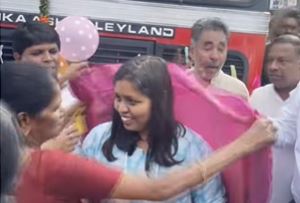
On August 11, the National People’s Power (NPP) Parliamentarian Lakmali Hemachandra and several Colombo Municipal Council members organised an event to re-launch the 155 bus service running from Colombo Town Hall to Mattakkuliya and Soysapura. Information obtained through a Right to Information (RTI) request from the Sri Lanka Transport Board (SLTB) on September 4, 2025, revealed that the SLTB was not officially notified about this event beforehand.
The deployment of this bus became a major political talking point because the new government is making a minor event, like a bus service re-launch, into a major news story.
The incident was heavily criticized on social media. Critics pointed out that the event, organized under the patronage of MP Lakmali Hemachandra and other NPP councillors, was a political spectacle that went beyond the proper function of a public transport service. Critics mocked the current government, noting that the same government had previously ridiculed past regimes for turning even the arrival of a ship at a port or a plane at an airport into political events. They argued that the current administration’s actions are even more ludicrous.

Political Interference and State Funds
Information obtained from the SLTB revealed several details about the event. The bus used (NA 3602) belongs to the SLTB and was purchased on November 21, 2006. It had previously operated on route numbers 03 (Avissawella) and 145 (Colombo), and later on the Mattakkuliya-Town Hall and finally the 155 route. The 155 bus service was temporarily suspended due to the COVID-19 pandemic, and the government decided to restart it due to public inconvenience.
However, maintenance work was carried out on the bus before it was deployed. The engine was repaired and the body was repainted, with the maintenance costing Rs. 227,920.00. This public expenditure on a bus was then turned into a political event. The Mattakkuliya depot stated that it was not involved in organising or spending money on the event. This clearly indicates that a political group organised the event and used state property for their political objectives. The fact that only Depot Manager Nihal Kumara and All Ceylon Transport Workers Union Chairman Anthony Perera attended on behalf of the SLTB is contrary to proper institutional procedure. This raises suspicions about how decisions within state institutions are made for political activities.
Public Expectations vs. Political Ploy
The public wants a regular, efficient, and reliable public transport service. Re-launching a service that was suspended due to the pandemic is an admirable action. However, turning it into a political event undermines its true purpose. At the event, MP Lakmali Hemachandra stated that buses would run every 30 minutes, with 6 buses operating for 36 trips a day. This small incident shows that instead of directly providing such information to the public, politicians prefer to present it through a political campaign event, indicating their desire to use these services for their own political gain rather than simply serving the public.
A Lesson for the Future
This incident highlights several key issues that need attention when improving public services in the future. State institutions must be independent of political influence. Public services should not be used by political parties for their promotional activities. This was a sentiment the current government expressed when they were in the opposition.
Furthermore, the launch or relaunch of any public service should follow a formal procedure. Formal decisions based on genuine need should be the priority, not holding political events. The money spent on bus maintenance, like the Rs. 227,920.00, ultimately comes from public taxes. This money should be used to provide maximum benefit to the public, and political interference should only be for the purpose of ensuring this happens efficiently.
Ultimately, this small incident raises deep questions about Sri Lanka’s political culture. The public wants real services, not political spectacles. Turning a bus into a political event clearly shows that genuine public needs are being ignored. This is a culture that must change in the future.


