
By Rahul Samantha Hettiarachchi
An inquiry conducted under the Right to Information (RTI) Act regarding the expenditure incurred and the experts involved in drafting the National Education Policy Framework of the new government—a topic currently under intense public discussion—has revealed that three major education institutions in the country have misled the applicant by providing contradictory responses.
While the right to information is considered a fundamental right in the global context, it is also guaranteed by the Constitution of Sri Lanka. Against this backdrop, the public’s access to information was further statutorily solidified under the Right to Information Act No. 12 of 2016 during the ‘Yahapalana’ government that came to power in 2015.
Among the key promises made by the National People’s Power (NPP) government to win public attention before coming to power, their pledge regarding transparency was prominent. However, RTI applications submitted to various state institutions over the past few months suggest that attempts by state bodies to hide information or offer evasive responses are more prevalent now than before. This incident serves as a clear example.
Background of the Incident
In July 2025, an RTI application was submitted to three public authorities—the National Institute of Education (NIE), the Ministry of Education, and the National Education Commission (NEC). The application sought details on the costs incurred for the new Education Policy Framework drafted in 2025 under the new government, the criteria for selecting the expert committee members, and the reasons for the non-implementation of the framework drafted previously (2020–2022).
Three Responses for the Same Information
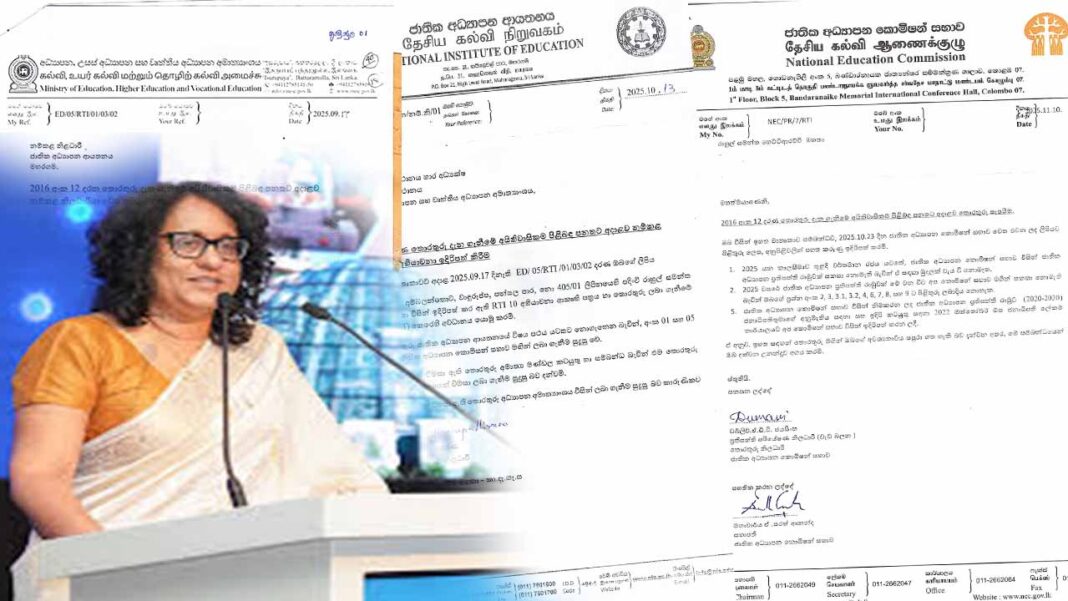
The responses provided by the three institutions regarding this request are as follows:
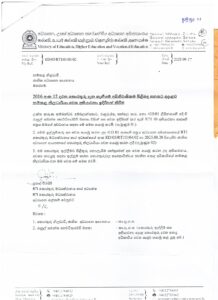
- National Institute of Education (NIE): In their response, the NIE stated that they do not possess this information. They directed the applicant to obtain cost and expert committee details from the National Education Commission (NEC) and cabinet-related information from the Ministry of Education.
- Ministry of Education: Contradicting the above, the Ministry of Education claimed that the “custodianship” of the relevant information lies with the National Institute of Education (NIE). Consequently, the Ministry forwarded the appeal back to the NIE.
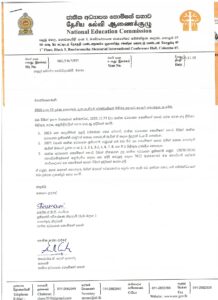
- National Education Commission (NEC): Providing the most startling response, the Commission stated that no such policy framework was drafted in 2025, and therefore, no funds were spent. They further noted that the policy framework drafted in 2022 is still awaiting approval from the Presidential Secretariat.
The Crisis of Transparency in Policy Making
At a time when the government is publicly discussing new educational reforms, it is a serious concern that no institution claims to possess data regarding the body responsible for drafting these policies or the public funds spent on them. While one institution shifts responsibility to another, the Commission’s claim of being unaware of such a policy highlights a glaring contradiction between official government announcements and actual institutional conduct.
Allegations have been raised that, instead of assisting the citizen as per Section 24 of the RTI Act, these institutions are attempting to conceal information by pointing fingers at one another. Regarding these misleading responses, an inquiry is currently being held before the Right to Information Commission under Appeal No. 1350/2025. The RTI Commission has decided to call for further hearings on these appeals on March 25, 2026.