
By Rahul Samantha Hettiarachchi
Amidst decades of socio-economic challenges, structural transformations, and recent financial turbulence, the bond between Sri Lanka and India has remained resilient, transcending conventional diplomatic ties. Anchored in geographical proximity, shared cultural heritage, and deep-rooted historical connections, this time-tested friendship has evolved into a robust development partnership. As Sri Lanka navigates its post-crisis recovery and strives to rebuild its socio-economic infrastructure, New Delhi’s unwavering support has emerged as a cornerstone of stability. Marking a significant milestone in this enduring alliance, the ground-breaking ceremony for a massive housing project aimed at constructing 10,000 houses for underprivileged families was recently held.
Scope of the Project and the Fourth Phase in Badulla
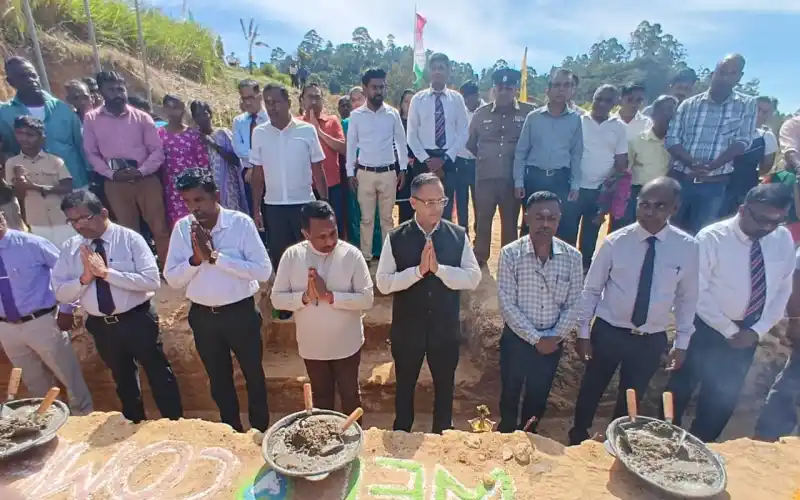
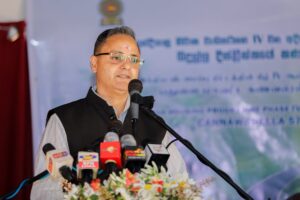
Under the fourth phase of the Indian Housing Project (IHP), funded through generous grants from the Government of India, the foundation stone was laid for 57 new houses at the Kannavarella Estate in the Badulla District. The event was graced by the Minister of Plantation and Community Infrastructure, K.V. Samantha Vidyaratne, alongside the Consul General of India in Hambantota, Harvinder Singh. The primary objective of this fourth phase is to construct 10,000 housing units across six provinces, specifically targeting marginalized estate sector communities.
On a broader scale, the Indian Housing Project envisions the construction of nearly 60,000 houses across Sri Lanka, backed by a massive financial commitment exceeding INR 18 billion. The success of this multi-phased initiative is already evident:
- Phases I & II: Successfully constructed or rehabilitated 46,000 houses in the war-affected Northern and Eastern Provinces.
- Phase III: Delivered 4,000 houses to plantation sector workers.
- Phase IV: Currently underway to build an additional 10,000 residential units.
This monumental initiative goes beyond merely laying bricks and mortar; it builds long-term stability and restores dignity to thousands of vulnerable families.
Uplifting the Plantation Community and Holistic Development
A remarkable facet of the Indo-Lanka development cooperation is its profound focus on the Indian Origin Tamil (IOT) community within the plantation sector. This community has served as a resilient pillar of the Sri Lankan economy for over two centuries, often despite facing systemic socio-economic hardships. Marking the 200th anniversary of their arrival in Sri Lanka, Indian Prime Minister Narendra Modi in July 2023 announced a comprehensive, multi-sectoral grant package worth INR 750 million to accelerate the development of this region.
Beyond housing, India’s holistic approach to community empowerment is visibly manifested through several landmark socio-educational and healthcare infrastructure interventions:
- The construction of the state-of-the-art Dickoya Hospital, providing critical healthcare access.
- The deployment of Smart Classrooms to bridge the digital divide for estate children.
- The comprehensive modernization of 9 key plantation sector schools.
- The development and preservation of the culturally significant Seetha Eliya Temple.
These initiatives demonstrate that Indian aid is not merely a diplomatic gesture, but a tangible, grassroots humanitarian intervention designed to elevate human capital.
Post-Crisis Rehabilitation and Future Horizons
For a nation recovering from the aftermath of its most severe economic crisis in modern history, large-scale infrastructure investments are vital for social healing and economic revitalization. Providing secure, high-quality housing is the first step toward restoring livelihoods, stabilizing communities, and offering a brighter future for the next generation. The active participation of high-level officials from both nations underscores a shared commitment to swiftly translating diplomatic goodwill into tangible human welfare.
Built on the foundation of mutual strategic interest, regional stability, and India’s “Neighbourhood First” policy, this mega-housing project stands as a shining testament to bilateral solidarity. It reaffirms that in times of adversity and transition, India remains a steady, compassionate, and reliable partner, guiding Sri Lanka toward a horizon of shared prosperity and enduring peace.